- Your cart is empty
- Continue Shopping


Double End Occluder: Red Maddox and Translucent
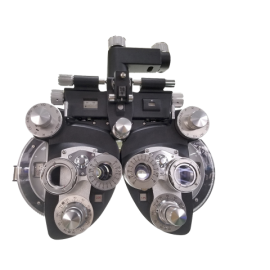
Maddox rods are used in conjunction with prisms measuring lateral and vertical phoria in both near and distant vision. The Maddox rod test can be performed in free space without use of the phoropter. Maddox rod phoria testing is a suitable alternative to the Von Graefe Phoria technique, and is indicated when a patient is unable to see two targets in the Von Graefe test.
1. Purpose
The Maddox Rod is a simple yet effective diagnostic tool used to detect and measure phorias and tropias, especially for identifying horizontal and vertical misalignments of the eyes (strabismus).
It is commonly used in binocular vision testing during cover tests and prism testing.
2. Components
-
Red Maddox Rod Lens – parallel cylindrical lenses.
-
Occluder Handle/Paddle – available in black, clear, or frosted.
-
Orientation Options – horizontal, vertical, or diagonal, depending on the test requirement.
3. How to Use
3.1 Patient Positioning
-
Seat the patient comfortably with both eyes open, focusing on a distant white light source (~6m / 20ft away).
-
Dim the room lighting to improve visibility of the light and resulting image.
3.2 Test Procedure
-
Place the Maddox Rod in front of one eye:
-
Horizontal orientation (cylinders) → detects vertical deviation.
-
Vertical orientation (cylinders) → detects horizontal deviation.
-
-
Uncovered eye sees the light as a white point.
-
Eye behind the Maddox Rod sees a streak/line of light (red if red lens, green if green lens, etc.).
3.3 Interpretation
-
Line passes through point of light → eyes are properly aligned.
-
Line offset from point of light → indicates deviation.
-
Line to the right → Exophoria/Exotropia (eye turns outward).
-
Line to the left → Esophoria/Esotropia (eye turns inward).
-
Line above/below → Vertical deviation (Hyper/Hypophoria/Tropia).
-
4. Prism Measurement (Optional)
-
Use prisms to neutralize the misalignment until the line passes through the point of light.
-
The prism power and direction indicate the magnitude and type of deviation.
5. Cleaning & Storage
-
Clean gently with a soft lens cloth and mild soap if needed.
-
Avoid alcohol-based cleaners.
-
Store in a protective case to prevent scratches or damage.